What it means
Imagine you need a kilo of tomatoes. You walk through the market. One stall shows one price, the next stall shows another. How do you know what is usual today?
Price transparency means that prices are open, recent and easy to compare. People can see roughly what a product costs, where, and when that information was collected.
It does not mean that prices are low. It does not mean that every seller charges the same. It only means that people are not left guessing.
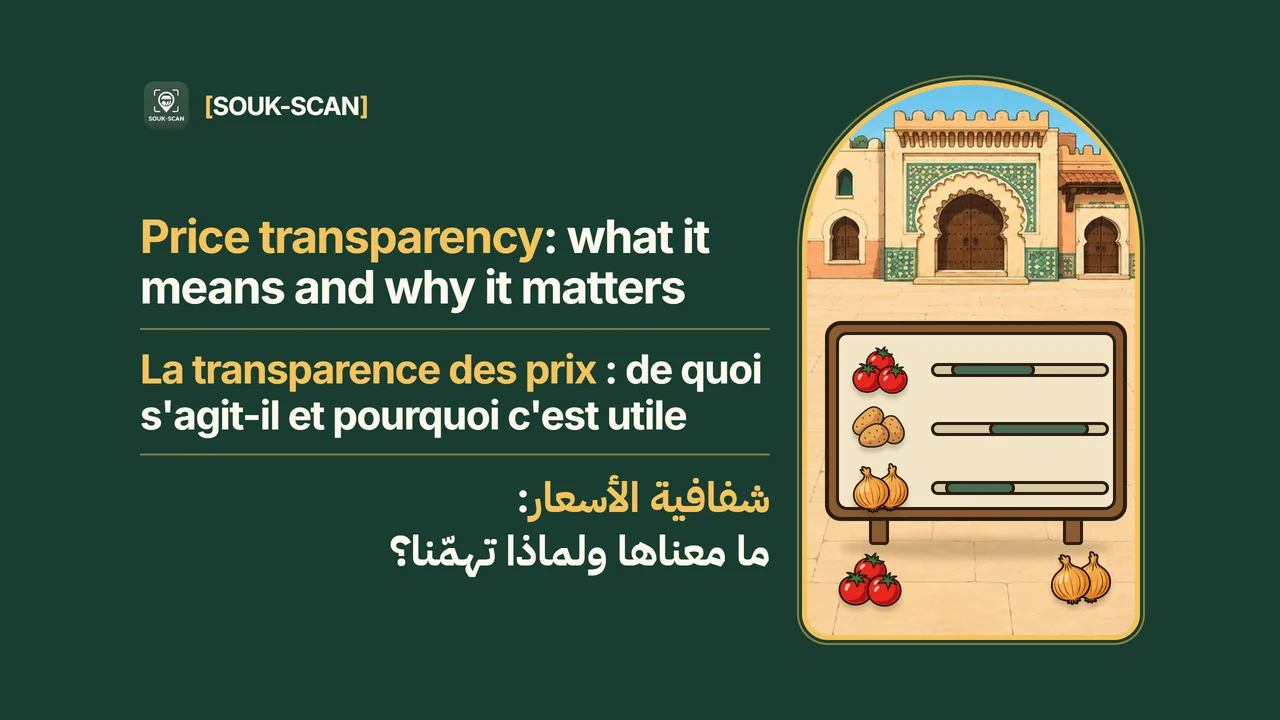
Think of a board at the entrance of a market that shows the usual range for the day's products. Nobody has to buy at those prices, and sellers are free to ask more or less. But everyone who walks in starts with the same information. That is the idea.
Why it helps a family budget
Food takes a large part of a Moroccan family's money. According to the High Commission for Planning (HCP), households spent 38.2% of their budget on food in 2022. For the least well-off tenth of the population the share was about 50%. For the best-off tenth it was about 30%.
When so much money goes to food, small differences add up over a month. If you know the usual range for potatoes, onions and tomatoes, it is easier to plan the week and decide how much to buy.
It also helps you notice when a price looks unusual. That is a reason to ask a question, not a verdict. Prices differ for good reasons: size, quality, freshness, place, time of day.
Why it helps markets work
Finding a price takes time and effort. When buyers and sellers cannot easily see what others pay, the same product can be sold at different prices at the same moment. The economist George Stigler described this in 1961: looking for information has a cost, so prices for the same goods can differ.
Here is a real example from Niger, a country in West Africa. In a study published in 2010, the researcher Jenny Aker looked at what happened when mobile phone service arrived between 2001 and 2006. Traders could now check prices in other markets. Price differences for grain between markets fell by 10 to 16 percent, and the effect was stronger where transport was more expensive.
Niger is not Morocco, and grain is not fresh vegetables. But the example shows what better information can do.
In Morocco, the Competition Council wrote in 2024 that in traditional street-level markets (weekly souks, neighbourhood markets, street stalls), price information is hard to find, prices can change from day to day, and bargaining is common. That is normal in an open market. A shared reference simply gives everyone a starting point.
Some differences will always remain, and many are fair. Transparency does not remove them. It helps people understand them.
Why it helps farmers and sellers
Farmers and small sellers also need to know the going price.
The Food and Agriculture Organization of the United Nations (FAO) explains that up-to-date market information helps farmers in several ways. They can negotiate from a stronger position. They can choose where and when to sell. And with past prices in hand, they can plan what to plant.
Traders can use the same information to send produce from a place that has plenty to a place that has less, and to decide whether storing a product is worth the cost.
A farmer who knows the usual price can judge an offer calmly. A shopkeeper who knows the usual wholesale price can plan purchases with more confidence.
What it cannot do
Transparency is useful, but it has limits. It is good to be clear about them.
It is not price control. Showing prices does not set, cap or freeze any price. Prices still move with supply, demand, weather and costs.
Data can be thin. If only a few people report a price, the picture is weak and can mislead. A range built on very few reports deserves less trust than one built on many.
Data can be old. Fresh produce can change price quickly. A price from last week may not be today's price. This is why the date always matters.
Not everything is comparable. Two lots of potatoes can differ in size, quality and origin. A single number cannot capture all of that.
It is hard to do well. An FAO study published in 1997 reviewed market information services in many countries. It found that most did not give farmers and traders information useful enough for business, and that many struggled to keep going once their funding ended. Good information needs to be regular and reliable to be worth using.
What SOUK-SCAN does
SOUK-SCAN is a mobile app that tries to bring a little of this openness to everyday produce in Morocco. People who shop report the prices they saw. The app combines these reports into a range for each region. It never shows one person's price, and nobody can see who reported what.
For some products, the app also shows a wholesale reference price taken from the weekly bulletins of Casa Prestations. It always shows the date of that bulletin. This reference is kept apart from the community range and is the same for the whole country. When there is not enough data for a product, the app says so instead of inventing a number.
A range is a guide, not a promise. It is one more piece of information to help you decide for yourself.
Sources
- HCP, note on living standards from the National Household Living Standards Survey 2022 (published 2024).
- George J. Stigler, "The Economics of Information", Journal of Political Economy, 1961.
- Jenny C. Aker, "Information from Markets Near and Far", American Economic Journal: Applied Economics, 2010.
- Morocco Competition Council, Opinion no. A/2/24 on competition in fruit and vegetable markets, March 2024.
- FAO, Market Information Services: Theory and Practice (Agricultural Services Bulletin 125), 1997.